SEARCH

MacLean KJ, Tidman MJ. Alopecia areata: more than skin deep. Practitioner 2013;257(1764):29-32
Alopecia areata: more than skin deep
23 Sep 2013
AUTHORS
Dr Kirsty J. MacLean BSc MB ChB, Foundation Year 2 Doctor
Dr Michael J. Tidman MD FRCP (Ed) FRCP (Lond), Consultant Dermatologist, Department of Dermatology, Royal Infirmary of Edinburgh, Edinburgh, UK
Article
Alopecia areata, from the Latin meaning hair loss limited to a circumscribed area, is a chronic inflammatory non-scarring condition affecting the hair follicle that leads to hair loss ranging from small well defined patches to complete loss of all body hair.
The hair follicle is preserved, and in about 80% of affected individuals there is spontaneous regrowth within a year.1 However, most patients experience more than one episode of hair loss.
Alopecia areata can present at any age, although 60% of patients develop their first episode of hair loss before the age of 20 years.2 In the UK, it accounts for around 2% of new patients attending dermatology clinics.2
Risk factors
There are no racial or gender differences but alopecia areata is slightly more common in those with Down’s syndrome.
There is a family history of the condition in 20% of cases indicative of a genetic basis. A positive family history is considered to be prognostic of troublesome alopecia areata, as are onset in childhood, ophiasis (involvement of the scalp hair margins), nail changes and concurrent atopic disease.1 However, the severity of hair loss at presentation appears to be the strongest predictor of long-term outcome.1
There is an association with autoimmune diseases, including vitiligo, diabetes, pernicious anaemia and thyroid disease, suggesting that alopecia areata itself is an autoimmune disease, although this is still unproven.1
Diagnosis
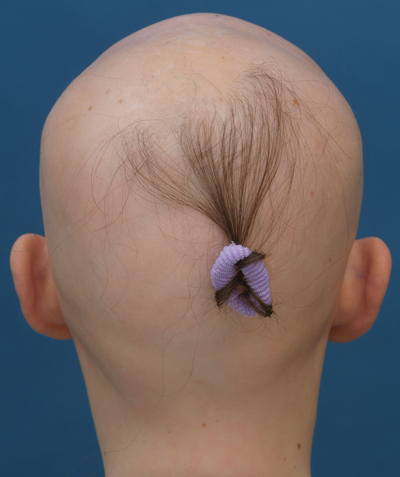
Alopecia areata normally presents with hair loss in discrete, well circumscribed patches, which may be small (< 1 cm) to very large, see figure 1, above. Any hair-bearing region may be affected, but the scalp is the most common site. Hair loss may rapidly extend to involve the entire scalp, when it is known as alopecia totalis. Rarely, there may be complete loss of all body hair termed alopecia universalis. Occasionally, alopecia areata presents as diffuse hair loss, lacking the well demarcated appearance of typical alopecia areata. The tendency for hair loss in alopecia areata to be confined to pigmented hair, leaving depigmented hair unaffected, is the reason behind the occasional observation of an adult ‘going grey overnight’.
The skin colour in lesions of alopecia areata is usually normal although it may sometimes be slightly erythematous, and the affected skin is silky smooth because of the absence of hair shafts. Gentle traction on the normal looking hairs immediately adjacent to areas of alopecia areata frequently results in clumps of hair being easily plucked (a positive pull test).
Close examination of the periphery of a lesion with a magnifying glass will often reveal short hairs which taper in diameter from their tip to the point at which they emerge from the skin, see figure 2. These ‘exclamation mark’ hairs are diagnostic of alopecia areata.
Regrowth commonly starts in the centre of a patch of alopecia, and the new hair often initially lacks pigment, see figure 3. In children, repigmentation usually occurs, but this cannot be guaranteed in adults. Individual patches of alopecia areata appear and resolve at different times.
Involvement of the eyebrows, eyelashes and nails may be helpful diagnostic clues. Pitting and longitudinal ridging of the nails occur in around 10% of cases.1
The differential diagnoses of alopecia areata are listed in table 1.
Investigations
Alopecia areata is essentially a clinical diagnosis, and confirmatory investigations are rarely necessary. However, in cases of diagnostic uncertainty, a skin biopsy, mycological examination or serological tests for syphilis or systemic lupus erythematosus may be indicated. In view of the association with autoimmune thyroid disease and pernicious anaemia, it is reasonable to explore the possibility of a predisposition to these disorders by measuring levels of circulating antibodies to thyroid and intrinsic factor.
Treatment
While alopecia areata is not detrimental to physical health, and although the reaction to alopecia will vary between individuals, it may have a very significant impact on psychological wellbeing in both children and adults. It is important to address the distress that this condition may cause.
Anxiety and depression, leading to social and work-related problems, are common in alopecia areata,1 and may require specific treatment.
Patient support groups can assist individuals in coping with their altered body image, but it is occasionally necessary to consider supportive help from a clinical psychologist.
The high rate of spontaneous remission in alopecia areata (excluding the totalis and universalis forms which have an unpredictable but generally poor prognosis for full recovery) impedes assessment of the efficacy of treatments, and thus the evidence base is thin.
The potential adverse effects of systemic immunosuppressive agents, such as glucocorticoids, ciclosporin and methotrexate, make it difficult to justify their use for a condition that does not affect physical health.
Furthermore, none of the available therapeutic options has been shown to alter the long-term outcome of alopecia areata.1
For those with alopecia areata of a mild or moderate degree who are not suffering psychologically, no treatment may be the best option in many cases. Supplying the patient with information about the condition may help in shared decision making, see External links.
Topical corticosteroids
Very potent topical corticosteroids are widely prescribed and considered reasonably safe but there is no convincing evidence of their efficacy. They can promote hair regrowth in some patients, however there are no data on long-term benefit.
It is reasonable to prescribe 0.05% clobetasol propionate, as a foam, shampoo or scalp application, to the affected scalp twice daily for a period of 12 weeks,1 while monitoring for signs of cutaneous atrophy. Folliculitis is a common side effect.
Intralesional corticosteroid injections
Intralesional triamcinolone acetonide can be quite effective in stimulating hair regrowth, confined to the areas that have been injected, although the benefits tend to be short lived, lasting only a few months.
It is a useful technique for small patches of hair loss and for sites such as the eyebrows, but is not appropriate for extensive or rapidly progressing alopecia areata and is not generally suitable for children. Side effects include skin atrophy at the injection site.
Systemic glucocorticoids
Oral or pulsed glucocorticoid therapy will produce some regrowth of hair in some patients, but the risk-benefit ratio is not considered favourable.1
Topical minoxidil
There are few data to suggest that topical minoxidil produces a cosmetically acceptable degree of hair regrowth in alopecia areata. Nonetheless, a trial of minoxidil lotion is a reasonable and safe therapeutic option.1
Calcineurin inhibitors
While there is evidence that ciclosporin does stimulate hair regrowth in some patients with alopecia areata, topical tacrolimus does not appear to be effective.1
Dithranol
Dithranol, applied sufficiently frequently and in a high enough concentration to produce an irritant reaction, will occasionally result in hair regrowth, although not often to a cosmetically acceptable degree, see figure 4, p31. Staining of skin and hair limits its use in fair-haired individuals.1
Photochemotherapy
PUVA (psoralen and ultraviolet A) therapy may be helpful, but response rates appear to be low and relapse is common.1
Contact immunotherapy
Contact immunotherapy is the best documented form of treatment for alopecia areata. It involves sensitising the individual to an unlicensed contact allergen, such as diphencyprone, and then continuing to apply it in a weak concentration, usually at weekly intervals, to the area of hair loss in order to maintain a mild dermatitis reaction.
As with all other treatments for alopecia areata, the response is unpredictable, producing cosmetically satisfactory hair regrowth in less than 50% of patients,1 and relapse is common.
Furthermore, the technique is not widely available, involves frequent hospital visits and may cause severe dermatitis, lymphadenopathy and rarely urticaria and pigmentation changes.
Wigs and prostheses
Individuals with widespread alopecia areata are usually eligible for prescribed monofilament acrylic wigs. Hairpieces, false eyelashes and eyebrows, hair extensions, semipermanent make-up and tattooing can all be effective in disguising hair loss in alopecia areata.
Referral
Individuals with alopecia areata should be referred for dermatological advice in the following situations:
• diagnostic uncertainty
• extensive hair loss
• severe psychological distress
• the patient would like a wig
Conclusion
Alopecia areata is a common and frequently distressing disorder, with the potential for causing considerable psychosocial debility.
It is difficult to treat, and, in the case of those individuals for whom treatment is considered appropriate, there is a paucity of evidence relating to the effectiveness of different therapies.
Despite its tendency to spontaneous remission and the fact that it does not impact on physical health, alopecia areata fully justifies further study of its cause and optimal management.
REFERENCES
1 Messenger AG, McKillop J, Farrant P et al. British Association of Dermatologists’ guidelines for the management of alopecia areata 2012. Br J Dermatol 2012;166(5):916-926
2 Delamere FM, Sladden MJ, Dobbins HM, Leonardi-Bee J. Interventions for alopecia areata. Cochrane Database Syst Rev 2008.Issue 2. Art No. CD004413 www.thecochranelibrary.com
ARTICLE IN PDF
 Download this article in PDF format
CLICK ON IMAGES


EXTERNAL WEBLINKS
British Association of Dermatologists
Patient information leaflets
Intralesional corticosteroid therapy
Primary Care Dermatology Society (UK)
Alopecia - male and female pattern alopecia
Support groups
PubMed reviews
NICE- evidence search